A slow front-end experience is a direct threat to an operator's bottom line. In the online gaming market, where product offerings are highly commoditised, technical speed is a major commercial differentiator. When players hold 3 to 5 active accounts, they have no patience for lagging interfaces. If your deposit screen takes too long to load, or your sports betting slip delays confirmation, players do not wait. They close your application and open a competitor's app. At Jurnii, our experience intelligence shows that any delay over 1.2 seconds on a transaction screen correlates with transaction abandonment. This is the 1.2-second cost. This delay directly impacts your first-time deposits (FTDs), net gaming revenue (NGR), and customer acquisition costs (CAC). To protect your marketing spend and retain your active player base, you must treat front-end performance as critical financial infrastructure. You must replace occasional point-in-time testing with continuous, automated experience monitoring.
How Front-End Performance Directly Controls iGaming NGR
Many iGaming operators build hybrid applications. They use web views or cross-platform frameworks to deploy a single codebase across iOS, Android, and desktop browsers. While this approach reduces engineering overhead, it frequently introduces severe performance issues. Hybrid applications are often bloated with heavy JavaScript bundles, excessive third-party tracking pixels, and large, unoptimized media assets. Every tracking script added by your marketing team, and every uncompressed banner uploaded by your content team, degrades page load speed. Under the Jurnii UX framework, performance is one of the four key dimensions we analyze, alongside Journey Effectiveness, Usability, and Perception. Jurnii UX evaluates your front-end experience under simulated mobile network conditions, matching the real-world connections of your players. We measure how quickly visual elements render, how long the page remains unresponsive to user input, and how much the layout shifts during load. A design team might argue that a visually dense lobby looks professional. However, if that lobby requires 3 megabytes of JavaScript to render, it will fail on a standard mobile network. By grounding performance in structured metrics, you replace aesthetic debates with objective evidence, allowing your engineering team to focus on optimizations that protect conversion.
Core Web Vitals and Commercial Consequence
Google's Core Web Vitals provide a standardized framework for measuring user experience speed. In online gaming, these metrics have a direct, quantifiable impact on player conversion and retention. Jurnii UX monitors these vitals continuously, mapping them to commercial consequences. The first metric is Largest Contentful Paint (LCP), which measures visual load speed. It tracks when the main content of a page is rendered. If a player opens your casino lobby and is met with a blank screen or a loading spinner for three seconds, your LCP is poor. The player assumes the application is broken, breaks their flow state, and logs out. The second metric is Interaction to Next Paint (INP), which has replaced First Input Delay (FID). INP measures page responsiveness. It tracks the latency between a user action, such as tapping a sports odds button, and the visual response on the screen. If a player taps an selection and the betslip fails to update immediately, they assume the tap was not registered. They tap the button again, creating duplicate selections or triggering error messages. This usability failure leads to immediate betslip abandonment. The third metric is Cumulative Layout Shift (CLS), which measures visual stability. It tracks whether elements on the page move unexpectedly during loading. In a sports betting context, poor CLS is a severe risk. If odds buttons shift dynamically as the player taps to place a bet, they may select the wrong odds or place a bet on the wrong event. This destroys player trust, causing immediate defection to a competitor.
Search Engine Optimization and Acquisition Efficiency
Front-end performance also controls your search engine optimization (SEO) and acquisition efficiency. Search engine algorithms use page load speed and mobile usability as primary ranking signals. If your homepage or registration landing pages are slow, search engines penalize your organic search visibility. This organic visibility penalty has a direct financial consequence. When your organic search rankings drop, you acquire fewer players through organic search. To maintain your acquisition volumes, you must increase your spend on paid search and affiliate channels. This shift increases your customer acquisition cost (CAC) and compresses your margins. You are forced to pay for traffic that you should have acquired organically. Optimizing your front-end performance is therefore a direct driver of marketing efficiency. A fast homepage increases your organic rankings, lowers your CAC, and ensures that the traffic you drive to your registration pages actually converts into depositors. Jurnii UX monitors your technical speed and SEO indicators, comparing your performance against your top competitors to ensure you maintain a structural acquisition advantage.
Digital Accessibility as a Regulatory and Commercial Imperative
Accessibility is frequently treated as an afterthought or a compliance checklist. However, it affects a significant percentage of players. Poor contrast ratios, missing keyboard navigation in lobbies, or unlabeled buttons on betslips prevent screen readers and assistive devices from using the product. In regulated markets, accessibility is also a compliance requirement. Regulators are increasingly auditing operator interfaces to ensure they are accessible to all users. A failure to meet accessibility guidelines can lead to regulatory warnings or fines. Beyond compliance, accessibility is a commercial opportunity. An accessible interface ensures that you do not exclude players with visual, motor, or cognitive impairments. Jurnii UX audits your user interface against international accessibility standards, identifying contrast issues, missing keyboard focus states, and incorrect HTML structures. By resolving these accessibility gaps, you expand your addressable market, protect your brand perception, and ensure compliance with regional regulations.
Continuous Performance Infrastructure vs. Snapshots
Many engineering teams run a performance test once before a major product release. They use free tools to generate a performance score, address the most obvious issues, and deploy the code. This point-in-time approach is a commercial risk. Performance degrades continuously in production. A marketing campaign might add three new tracking pixels. The content team might upload an uncompressed 2-megabyte image to the homepage slider. The backend database may experience latency spikes during peak sporting events. A snapshot audit cannot capture this real-world degradation. To maintain a speed advantage, you need continuous experience intelligence. Jurnii UX replaces snapshots with always-on monitoring. We audit your digital experience continuously, tracking how performance metrics vary by region, device, and network speed. This continuous data stream gives you immediate commercial visibility. When a new release or a content update degrades your page load speed, Jurnii alerts you immediately, before the latency impacts your conversion rates and reduces your NGR. This proactive monitoring ensures your product remains fast and competitive every day.
Elevating Performance on the Product Roadmap
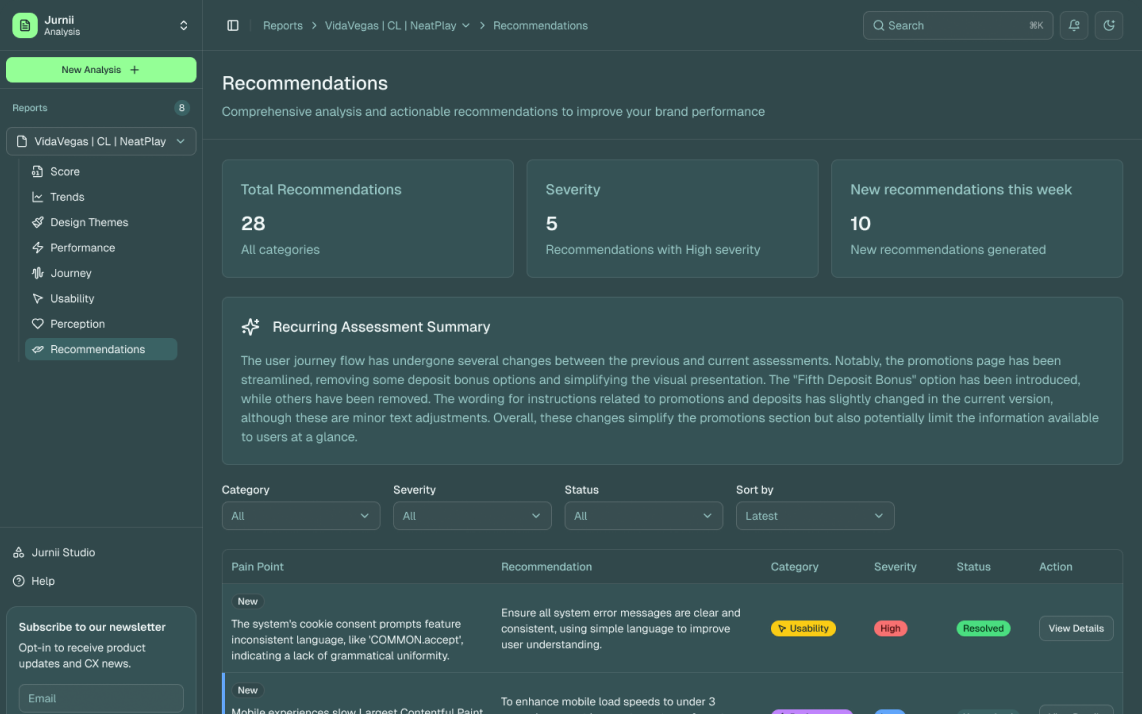
To win on experience, operators must treat technical speed as a commercial product feature. Performance optimization must be prioritized on the product roadmap alongside new games and promotional mechanics. By using Jurnii UX, you replace subjective debates about feature development with structured, commercially weighted recommendations. The platform ranks performance issues by their revenue impact, showing your product team exactly where latency is costing you deposits. This data-backed prioritization aligns your product and engineering teams. They no longer argue about design preferences. Instead, they work systematically to remove the friction points that leak FTDs and lower player lifetime value. Do not allow a slow interface to limit your NGR. Optimize your front-end performance. Benchmark. Act. Outperform.