Blog

Jurnii News & Blog

Discover insightful blog articles from Jurnii that highlight key benefits and enrich your understanding. Each piece is crafted to engage and inform, ensuring you gain valuable knowledge in just a few lines.
Fallback Jurnii Image
Jul 3, 2026

VIP Retention in the Friction Age

The Pareto principle is highly pronounced in the online gaming sector. Across most operator databases, a small cohort of players—approximately 10% of the active player base—drives over 80% of the total Net Gaming Revenue (NGR). These high-value players, commonly categorized as VIPs or premium players, are the financial backbone of any gaming business. To retain this critical audience, operators invest heavily in commercial VIP managers, personalized customer service, sports hospitality, and customized promotional gifts. However, this traditional retention strategy has a major blind spot. It ignores the core product experience. VIP players interact with your application far more frequently than recreational players. They log in multiple times a day, navigate lobbies, place live in-play wagers, play high-stakes casino games, and make regular transactions. This high frequency of interaction makes them extremely sensitive to user interface friction. When a high-value player experiences design bugs, slow loading times, validation errors, or security concerns, they do not complain to their dedicated account manager. They do not wait for your customer service team to resolve the issue. Because they hold active accounts with 3 to 5 competitor brands, they simply close your application and open a competitor's app. This defection is silent. To protect your core revenue stream, you must replace relationship-based VIP management with product-led VIP retention, ensuring your digital interface is optimized to deliver a fast, reliable experience during every session.


Fallback Jurnii Image
Jul 10, 2026

The Psychology of the Multi-Homing Player

In the early years of online gaming, player loyalty was a defensible asset. Operators acquired players through marketing campaigns and retained them through high switching costs. In the desktop era, registering a new account, verifying an identity, and entering credit card details was a slow process. Once a player established an account, they tended to remain loyal to that brand. Today, player loyalty is dead. The modern online gaming player is a multi-homer. According to Jurnii’s market intelligence database, 70% to 80% of active players in regulated markets hold accounts with 3 to 5 different operators simultaneously. They keep these applications installed on their mobile devices, organized in gaming folders. The cost of switching between these apps is zero. Registering a new account takes under two minutes, and payment methods like Apple Pay and Google Pay allow players to deposit funds instantly. In this environment, you do not own your player base. You compete for their wallet share during every session. Retention is not won by brand marketing or retrospective loyalty programs. It is won at the level of digital experience. The operator who delivers the fastest, most reliable interface during critical moments retains the player's primary wallet share. The operator who introduces friction triggers an immediate switch to a competitor.

Fallback Jurnii Image
Jul 13, 2026

The iGaming CFO's Guide to UX

For the Chief Financial Officer, user experience (UX) has historically been viewed as a soft, aesthetic cost center. When product and design teams request capital to fund interface redesigns or new front-end development, they often present their proposals using subjective, non-financial terminology. They argue that a new layout will make the application feel more modern, or that it will make the registration flow more engaging. To a CFO focused on margin protection, rising taxes, and capital allocation, these aesthetic arguments carry little weight. Design changes must not be evaluated on visual appeal. They must be measured by their direct impact on the balance sheet. In the online gaming industry, where player acquisition costs (CAC) are rising and retention is low, usability is a primary driver of financial performance. Under the Jurnii UX framework, we translate experience metrics directly into financial Key Performance Indicators (KPIs). We connect page load speed, input error rates, and security placement to first-time deposits (FTDs), hold rates, and Net Gaming Revenue (NGR). By grounding your user experience decisions in financial reality, you convert design from a speculative expense into a measurable revenue driver, ensuring that every engineering hour invested delivers a clear, quantifiable return.

Fallback Jurnii Image
Jul 6, 2026

Why Most iGaming A/B Tests Fail and How to Fix Them

‍A/B testing is the standard tool for conversion rate optimization (CRO) in the online gaming industry. Product and marketing teams routinely launch experiments on registration forms, deposit screens, and casino lobbies, hoping to find a layout that increases first-time deposits (FTDs) and player lifetime value. However, the reality of iGaming experimentation is a story of wasted effort. Up to 70% of product experiments fail to show a statistically significant result, or they reveal a negative impact on conversion. This high failure rate is an expensive operational drag. It consumes valuable front-end engineering hours, delays critical product releases, and leaves operators with flat conversion metrics. The cause of this experimentation deficit is simple: operators base their A/B testing hypotheses on subjective opinions, aesthetic trends, or competitor screenshots, rather than objective benchmarking data. To build a highly efficient CRO operation, you must replace assumption-based testing with hypothesis-driven experimentation. By aligning your testing pipeline with Jurnii's experience intelligence, you focus your engineering resources on the specific friction points that are leaking revenue, increasing your experiment win rate and growing your Net Gaming Revenue (NGR).

Fallback Jurnii Image
Jun 29, 2026

A Framework for Implementing 70+ UX Recommendations

Finding user experience flaws in an online gaming product is relatively straightforward. If you run a standard usability audit, use heatmaps, or conduct user testing session reviews, you will quickly identify dozens of friction points. The real challenge is execution. In the complex iGaming environment, translating diagnostic findings into live, compliant, and high-converting product improvements is an operational bottleneck. Many operators invest in comprehensive consulting audits only to receive a 150-page presentation slide deck. This document outline is too dense, lacks commercial priority, and fails to account for technical feasibility. As a result, the audit is archived, and the friction points continue to leak first-time deposits (FTDs) and reduce player lifetime value. At Jurnii, we believe that diagnostic audits are only valuable if they lead to rapid product execution. Jurnii Studio's Design Solutions is built to bridge this execution gap. By using a structured translation framework, we help product and engineering teams convert the Jurnii UX platform's 70+ ranked recommendations into live, optimized interface components, accelerating your release cycles and protecting your net gaming revenue (NGR).

Fallback Jurnii Image
Jun 22, 2026

How to Respond to Competitor Promo Attacks in Real-Time

In the hyper-competitive iGaming market, competitor promotional campaigns are not just marketing announcements. They are direct promo attacks designed to capture player wallet share. Because players hold active accounts with multiple operators, a sudden spike in competitor generosity can immediately divert your active player base. If your commercial team only discovers a competitor's campaign days after it launches, you are playing a losing game of reactive defense. Waking up to find your registration rates have dropped, or your first-time deposits (FTDs) have shifted, means you have already lost valuable players. The delay in response represents a direct cost to your Net Gaming Revenue (NGR). To protect your player base and defend your margins, you must automate your competitive surveillance. You need real-time change detection that monitors the market continuously. By reducing your competitive response time from days to under two hours, you replace panic with structured strategy. Jurnii 360's change detection and automated alerts give you the commercial visibility needed to make calm, profitable decisions that protect your hold rate and secure your player base.

Fallback Jurnii Image
Jun 15, 2026

Accounting for Competitor Noise in Marketing Attribution

Marketing Mix Modeling (MMM) has become the standard framework for budget allocation in the online gaming sector. Operators use these statistical models to determine the optimal distribution of their marketing spend across digital acquisition channels, television advertising, sponsorship deals, and affiliate networks. However, the majority of these models suffer from a fundamental structural flaw: they analyze performance in a vacuum. By only ingesting internal data—such as media spend, impression volumes, and campaign timings—traditional models ignore the single largest driver of player behavior in iGaming. That driver is competitor activity. iGaming is a hyper-competitive, multi-homing market. Players do not make deposit decisions based solely on your marketing creative. They evaluate your offers against the active market set. If your attribution models do not account for competitor promotional volume, generosity shifts, and creative cycles, they will produce biased results. They attribute revenue fluctuations to the wrong variables, leading to incorrect budget decisions that dilute your marketing efficiency and compress your net gaming revenue (NGR).

Fallback Jurnii Image
Jun 8, 2026

Optimizing iGaming Promotional Spend Without Diluting Margins

Setting promotional budgets in the online gaming industry is historically a guessing game. Operators allocate millions of pounds to player bonuses, odds boosts, and free bets without objective market context. They operate out of fear, assuming they must match or exceed every competitor campaign to protect their player base. This blind approach to player incentives leads to severe margin dilution. Conversely, operators who restrict their budgets too tightly risk offering uncompetitive promotions, losing active players to rivals. To build a sustainable commercial operation, you must optimize your promotional spend. You must replace subjective assumptions with structured market data. The Promo Richness Index is Jurnii's proprietary metric that quantifies promotional generosity across sportsbooks and casinos. It translates complex, fine-print terms and conditions into a standardized numerical value. By using always-on experience intelligence, you can see exactly where your promotions stand relative to your competitive set. This commercial visibility allows you to protect your trading margins and hold rates while remaining highly competitive in key verticals.

Fallback Jurnii Image
Jun 1, 2026

Building a Modern Competitive Intelligence Unit in iGaming

Commercial teams in iGaming are wasting valuable resources on manual data collection. In many operator organizations, highly paid commercial analysts, CRM managers, and trading specialists spend a significant portion of their week acting as manual data entry clerks. They sign up for competitor accounts, log in daily, take screenshots of homepage banners, and manually copy promotional terms into shared spreadsheets. This process is slow, expensive, and structurally flawed. By the time this manual research is compiled and analyzed, the competitive landscape has already shifted. In a market defined by razor-thin margins, rising taxes, and intense player multi-homing, speed to market is a major commercial differentiator. You cannot run a competitive commercial operation using stale data. To protect your player base and maximize promotional efficiency, you must automate your competitive research. You need an automated intelligence layer that acts as an always-on commercial radar. By converting manual competitor tracking into structured, near-real-time intelligence, you save hours of engineering and analysis time. You give your commercial team the visibility needed to make fast, evidence-based decisions that protect your hold rate and grow your net gaming revenue (NGR).

Fallback Jurnii Image
May 25, 2026

How Digital Experience Shapes Player Sentiment and Brand Loyalty

Brand trust is not built by multi-million-pound television campaigns, sports sponsorships, or celebrity endorsements. These marketing efforts can drive brand awareness and encourage players to visit your landing pages. However, they do not create trust. Trust is built or broken during digital interactions. It is formed when a player registers an account, makes a deposit, places a bet, or requests a withdrawal. In the iGaming market, where player loyalty is fragile and the cost of switching is zero, digital trust is a critical commercial asset. Under the Jurnii UX framework, Perception is the fourth key dimension we analyze, alongside Journey Effectiveness, Usability, and Performance. Perception measures how effectively your product communicates security, reliability, and transparency throughout the player journey. When verification flows fail, or when reassurance is missing during a transaction, trust erodes. This erosion is silent. Players do not complain; they simply defect. To protect your Net Gaming Revenue (NGR) and customer acquisition cost (CAC), you must replace subjective brand tracking with structured experience audits, ensuring that your digital interface actively builds trust at every touchpoint.

Fallback Jurnii Image
May 18, 2026

How Front-End Performance Directly Controls iGaming NGR

A slow front-end experience is a direct threat to an operator's bottom line. In the online gaming market, where product offerings are highly commoditised, technical speed is a major commercial differentiator. When players hold 3 to 5 active accounts, they have no patience for lagging interfaces. If your deposit screen takes too long to load, or your sports betting slip delays confirmation, players do not wait. They close your application and open a competitor's app. At Jurnii, our experience intelligence shows that any delay over 1.2 seconds on a transaction screen correlates with transaction abandonment. This is the 1.2-second cost. This delay directly impacts your first-time deposits (FTDs), net gaming revenue (NGR), and customer acquisition costs (CAC). To protect your marketing spend and retain your active player base, you must treat front-end performance as critical financial infrastructure. You must replace occasional point-in-time testing with continuous, automated experience monitoring.

Fallback Jurnii Image
May 11, 2026

Designing for the Flow State

Internal design debates frequently delay product roadmaps in iGaming organizations. Product managers, designers, and commercial executives spend hours arguing about aesthetic choices. They debate the color of a deposit button, the layout of a sports betting slip, or the density of a casino lobby. These discussions are typically led by subjective style opinions or the highest-paid person's preference. This is a costly operational distraction. Subjective debates do not improve conversion rates, protect player retention, or increase net gaming revenue (NGR). To accelerate your product development cycle and optimize player value, you must replace opinion with structured benchmarking. Usability is not a matter of taste. It is an objective measure of how easily players navigate, understand, and interact with your product. By applying classic usability heuristics to your digital interfaces, you can eliminate subjective design debates and align your team on a data-backed product roadmap. The primary goal of usability optimization in online gaming is to establish and protect the player's flow state. In this state of focused engagement, the interface becomes invisible, allowing the player to focus entirely on their entertainment. Any cognitive friction, no matter how minor, breaks this flow state, causing players to log out and switch to a competitor.

Fallback Jurnii Image
May 11, 2026

Mapping the Friction Points: A Masterclass in iGaming Transactional UX

iGaming operators spend millions of pounds on player acquisition. They optimize their marketing channels. They bid on expensive keywords. They sign high-profile brand ambassadors. Yet, much of this investment is wasted because of a critical failure at the point of conversion. Minor, unnoticed friction points across key transactional journeys silently kill conversion rates every day. When an operator loses a player during registration, deposit, or withdrawal, it is rarely due to a single catastrophic technical error. Instead, it is the result of cumulative friction. It is the weight of two extra form fields, a poorly sequenced verification step, or a moment of hesitation introduced by a confusing interface decision. To protect your customer acquisition cost and maximize player lifetime value, you must treat transactional journeys as critical commercial infrastructure. This requires a systematic, data-driven approach to mapping and resolving friction points.

Fallback Jurnii Image
May 4, 2026

Domain-Specific AI in iGaming: Why Generic LLMs Fail the Compliance and UX Test

Many iGaming executives are currently making a costly strategic mistake. They are rushing to integrate generic artificial intelligence into their product and marketing workflows. They deploy off-the-shelf Large Language Model wrappers. They adopt vendor-bundled features that promise to automate copywriting or design reviews. They believe this technology provides a competitive edge. It does not. When every operator uses the same underlying public models, the result is not differentiation. It is commodity parity. In a highly regulated, hyper-competitive market, parity is a slow death. To build a durable commercial advantage, you must move beyond generic tools. You need proprietary, domain-specific intelligence infrastructure. The first wave of AI adoption in iGaming has focused on broad, horizontal models. These models are trained on the open internet. They excel at general writing and basic reasoning. However, they fail when applied to the specific, high-stakes requirements of regulated gaming. They do not understand the commercial mechanics of player journeys. They cannot navigate the complex compliance boundaries of regional regulators. They cannot distinguish between a high-performing transactional interface and a compliant but commercially restrictive flow. To survive margin compression and rising customer acquisition costs, operators must invest in specialized intelligence. You must replace subjective opinion and generic automation with structured, domain-specific benchmarking. This is the only way to convert raw data into net gaming revenue.

Fallback Jurnii Image
Apr 27, 2026

The Strategic Blind Spot of Quarterly Snapshots

Many iGaming executives operate under a comfortable illusion. They believe they have a clear view of their competitive landscape because they commission a quarterly agency audit, or because they have a team member manually review competitor homepages every Monday. This is not market awareness. It is a snapshot. In a market that moves daily, relying on quarterly snapshots is a commercial liability. It creates a temporary illusion of safety while leaving you systematically uninformed during the weeks and months between reviews. The modern iGaming market does not wait for your quarterly planning cycles. Competitors adjust their promotional mechanics, alter their onboarding journeys, and launch aggressive acquisition campaigns in near-real-time. Operating without continuous, automated visibility means you are making critical product and commercial decisions using stale evidence. To survive margin compression and protect your player base, you must convert periodic reviews into always-on intelligence.

Fallback Jurnii Image
Apr 20, 2026

Why Reactive Analytics Cost You FTDs

Traditional analytics platforms explain the past. They tell you that your conversion rate dropped last month. They tell you that player churn increased last quarter. They explain what went wrong after the commercial damage is done. For an iGaming operator, this reactive approach is a costly way to manage a product. By the time friction shows up in your database, you have already lost the player, the First Time Deposit (FTD), and the customer lifetime value. To protect your Net Gaming Revenue (NGR), you must identify friction points before they affect your revenue. You need proactive UX intelligence.

Fallback Jurnii Image
Apr 13, 2026

Speed is Commercial Leverage

The gap between identifying a market shift and reacting to it determines whether you lead or follow. In a commoditised market, operators compete on thin margins. The speed of your decision cycle is a commercial differentiator. Many operators mistake speed for rushing. They make reckless product changes or launch reactionary campaigns with poor data. True speed is different. It is about decision velocity. It is about having the structured intelligence to make decisions at 85% confidence, rather than waiting for certainty that never arrives. If you wait for 100% certainty, the opportunity has already passed.

Fallback Jurnii Image
Apr 6, 2026

Experience is the Last Defensible Advantage

The iGaming market has reached a point of structural commoditisation. Most operators run on the same B2B platform stacks. They license the same game libraries. They match the same odds. They copy the same promotional mechanics. If five operators run on the same technology stack, they are competing on a reskin. They are not competing on product. Differentiation cannot wait on vendor roadmaps. In this environment, the player's decision to stay, return, or defect is made at the level of experience. Experience is the last defensible moat.

Fallback Jurnii Image
Mar 26, 2026
Fraser

AI Is Exposing the Weakest Links in Online Casino UX

In a recent interview with Casinos.com editor Alan Evans, Fraser talked about why operators are still losing players - "the problem is not a lack of data but a lack of insight into why customers drop off.”

Fallback Jurnii Image
Conversation
Mar 10, 2026
Fraser

‍‍The Big Trends and Talking Points From ICE 2026

After iGaming’s key figures descended on Barcelona to talk business earlier this year, ICE was the place to take the true pulse of the gaming industry. Fraser Dunk joined an iGaming Business webinar panel hosted by James Swann-Phillips.

Fallback Jurnii Image
Mar 19, 2026
Fraser

From Analytics to Action: The Next Phase of iGaming Insight

As automation and AI continue to reshape how data is used across gaming, operators are reassessing the limits of traditional analytics. In an interview with G3 Media, CEO Fraser Dunk explores why the industry must move beyond passive reporting towards proactive UX research and intelligent automation - and how these capabilities are emerging as true competitive differentiators. From turning insight into execution, to embedding real-time optimisation within the player journey, Fraser outlines what the next evolution of iGaming performance looks like.

Fallback Jurnii Image
Insights
Mar 12, 2026
Tristan

UX Insights: iGaming in Brazil

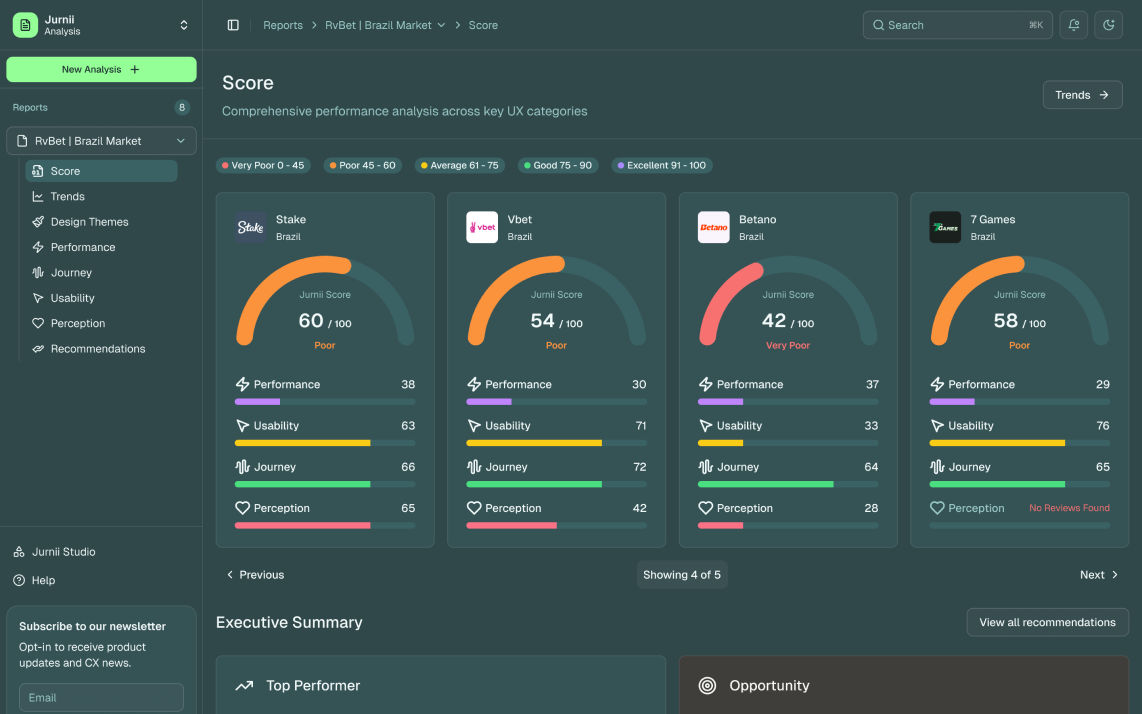
With the recent legalisation of online gambling in Brazil, the country is set to be a big player in the iGaming industry. Naturally, we got curious. Jurnii wanted to look at the leading iGaming brands that operate in Brazil to test how they are performing when it comes to UX - who is leading the way and who is falling short?

Fallback Jurnii Image
Conversation
Mar 5, 2026
Fraser

Fraser Dunk and Karolina Pelc on Building an AI Business in a Slower Funding Era

In an exclusive interview with Next.io, Jurnii CEO, Fraser Dunk and company backer, Karolina Pelc share their perspectives on founder mistakes, competitive intelligence, and sustainable growth. Together, they also explore the rationale behind the partnership and the company’s plans for the future.

Fallback Jurnii Image
Conversation
Mar 3, 2026
Mitch

Real-Time UX Intelligence Is Changing iGaming

In a recent conversation with SiGMA World, our Chief Commercial Officer, Mitch Vidler, discusses the industry trends reshaping operator strategies. Competition is intensifying as stricter advertising rules continue to roll out, meaning operators are becoming less reliant on acquisition-led growth and placing greater emphasis on retention, customer experience and share of wallet. Mitch explores this shift, alongside the evolving role of pricing and promotions, and how real-time intelligence is increasingly shaping commercial decision-making.

Fallback Jurnii Image
Announcement
Feb 17, 2026
Fraser

Jurnii In The Press - Here's What We've Been Saying

Over the past few weeks, our CEO Fraser Dunk has been speaking with individuals across the iGaming media. Some of the key topics include; exploring how AI-driven UX intelligence can surface problems before players feel them, the most dominant topics that emerged at Fira Barcelona and why operators are still losing players due to lack of insight. Here’s a round-up of the most recent discussions.

Fallback Jurnii Image
Insights
Feb 10, 2026
Tristan

UX Insights: iGaming in Canada

We recently ran a UX performance report across five leading iGaming brands that operate in Canada: BC.Game, Stake, Shuffle, Betty, and PlayOJO. The data highlights a competitive Canadian iGaming market, with strong UX foundations in place, but clear gaps in customer experience (CX) where user trust and engagement start to break down.

Fallback Jurnii Image
Announcement
Jan 22, 2026
Fraser

Jurnii Reflection and New Investors

Before we look into 2026, let’s reflect on our key achievement from last year. In February 2025, we launched our first product, Jurnii UX. Since then, we have grown to 15 active Jurnii UX clients and have ran detailed UX audits on over 300 brands. In October, we launched Jurnii 360. Brought in automated insight clustering, AI-generated recs, and scorecard tracking. A whole new layer of visibility for product and CX teams. We welcomed new investors, new partners and continue to grow the Jurnii team. A huge year with a lot more exciting announcement to come…

Fallback Jurnii Image
Insights
Aug 13, 2025
Fraser

The product leader's guide to AI-powered UX benchmarking

Product leaders face constant pressure to deliver exceptional customer experiences while contending with traditional research methods that are often slow, expensive, and difficult to scale. This guide explores how AI-powered UX benchmarking is changing the way product teams gather insights, make decisions, and stay ahead of the competition, all without draining resources or extending deadlines.

Fallback Jurnii Image
Insights
Aug 5, 2025
Fraser

Insights at scale: the AI path to better CX

The customer experience industry is changing. AI is a key part of this shift, helping businesses deliver faster, more strategic, and impactful customer experiences. Let’s explore how AI is redefining CX and what is coming next.

Fallback Jurnii Image
Conversation
Jul 2, 2025
Fraser

Is Your Bad UX Bleeding Customers? Unlock the Secret to iGaming Retention

Product leaders face constant pressure to deliver exceptional customer experiences while contending with traditional research methods that are often slow, expensive, and difficult to scale. This guide explores how AI-powered UX benchmarking is changing the way product teams gather insights, make decisions, and stay ahead of the competition, all without draining resources or extending deadlines.

Fallback Jurnii Image
Insights
Jun 10, 2025
Fraser

Understanding AI agents for CX, UX, and product leaders

The term 'AI Agent' is everywhere. But for CX, UX, and product leaders, what does it actually mean for your strategy? This isn't about adopting the latest trend, but about fundamentally reshaping customer experience through AI. In this article, we provide clarity on when and how to implement AI Agents into your existing CX strategy and outline the balancing act when delivering value through AI-enabled solutions versus human-AI collaboration.

Fallback Jurnii Image
Announcement
Jun 9, 2025
Fraser

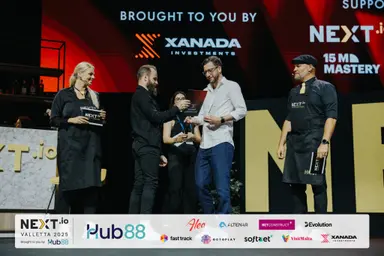
Jurnii AI Wins Public Choice Award at NEXT iGaming Conference

We're thrilled to share that Jurnii AI was crowned Public Choice Award at NEXT Summit. Read the highlights and watch our winning pitch.

Fallback Jurnii Image
Insights
May 12, 2025
Fraser

Unlock faster CX insights with 'vibe coding' for human-AI collaboration

Learn why vibe coding is the hottest trend for product and UX teams, combining human-AI collaboration, customer experience and AI prompt engineering to build a better digital experience with Jurnii AI.

Fallback Jurnii Image
Insights
Jan 15, 2025
Fraser

The Rise of AI-Powered Service Agencies

The rise of AI-Powered Service Agencies We’re witnessing the rise of a new type of agency—AI-powered service providers

Fallback Jurnii Image
Insights
Dec 19, 2024
Fraser

The convergence of UX and CX, how Jurnii delivers a unified experience solution

“Customers don’t view UX and CX separately—and neither should you.”

Fallback Jurnii Image
Insights
Nov 22, 2024
Fraser

What does Customer Experience mean to Jurnii?

Customer Experience is more than just fixing issues, it’s a business enabler that drives growth, efficiency, and customer loyalty. With AI-powered tools like Jurnii, companies can automate processes, benchmark performance, and focus on strategic CX improvements that deliver real commercial impact.