The lines between User Experience (UX) and Customer Experience (CX) are blurring. As businesses prioritise end-to-end journeys, the integration of UX and CX has become essential to delivering seamless, customer-centric strategies.
According to a recent Nielsen Norman Group article,
"UX and CX are no longer separate disciplines; they must be aligned to deliver cohesive experiences across all touchpoints."
At Jurnii, this philosophy is at the core of our approach. By combining AI-powered insights and human expert consultancy, we help businesses unify their digital experiences—streamlining design, interaction, and customer satisfaction into a single, measurable strategy.
What Does the Merging of UX and CX Mean? Historically, UX focused on improving specific product-level interactions—like the usability of a website, an app, or digital product. Meanwhile, CX measured and optimised the broader customer journey across all touchpoints, from marketing to post-purchase support.
However, customers don’t distinguish between a product’s usability and their overall brand experience. As Nielsen Norman Group emphasises:
“Customers view their experience holistically. Whether interacting with an app, a website, or customer support, their perception of a brand is shaped by all these moments combined.”
This means UX can no longer operate in a silo. CX strategies must incorporate interaction-level improvements to deliver cohesive, end-to-end experiences.
How Jurnii Aligns UX and CX for Impact At Jurnii, our tools and services are designed to identify experience gaps and resolve them—ensuring brands deliver consistency across every digital touchpoint.
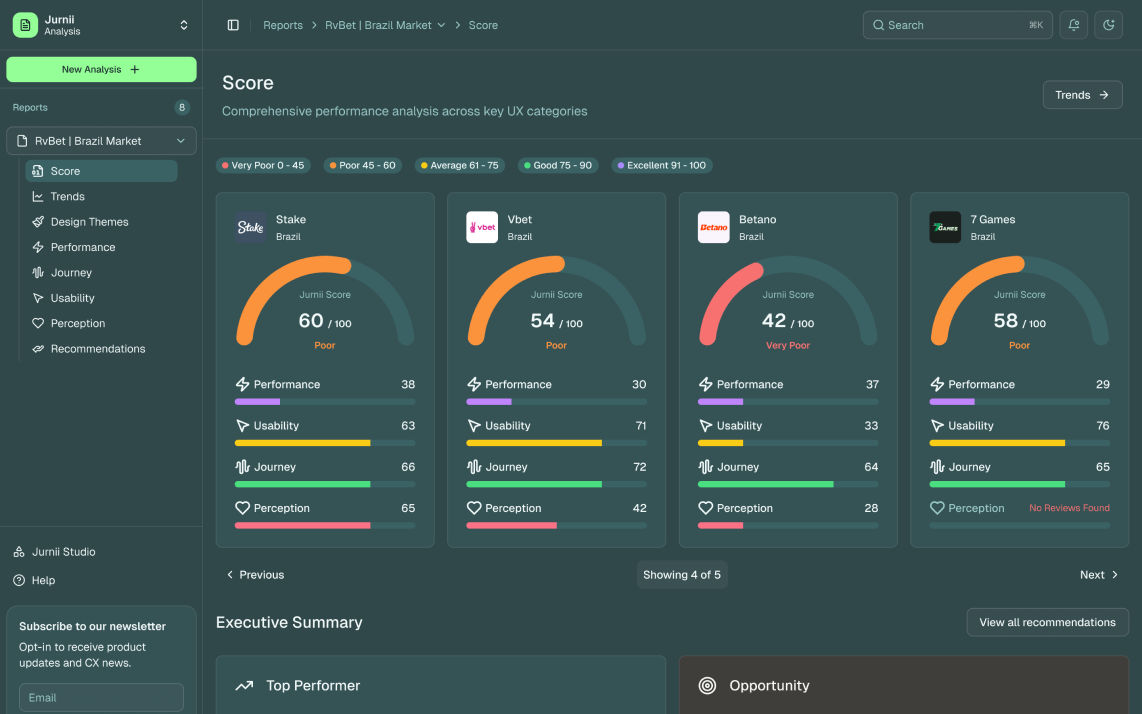
UX-Level Insights: Performance, usability, and accessibility audits for websites and apps. CX-Level Insights: Customer sentiment, satisfaction scores, and user journey efficiency.
By combining these metrics, Jurnii AI provides a comprehensive view of a brand’s digital health—benchmarked against competitors and backed by AI-powered recommendations.
Streamlining customer journeys across channels Improving usability at the interaction level Bridging data insights and design strategy
This holistic approach ensures that every user interaction contributes to a seamless customer experience.
Why Merging UX and CX is a Competitive Imperative As Nielsen Norman Group points out:
“Companies that align UX and CX don’t just solve pain points—they create moments of delight that drive loyalty and differentiation.”
In a competitive landscape, delivering a unified UX/CX strategy has tangible benefits:
Higher customer satisfaction: Smoother experiences reduce frustration and friction. Stronger brand loyalty: Consistent experiences drive customer trust and repeat business. Improved efficiency: Unified insights streamline processes across teams (e.g., design, marketing, support).
The Jurnii Advantage: Where UX Meets CX At Jurnii, we believe that the convergence of UX and CX is the key to unlocking sustainable business growth. Our AI-powered tools and consultancy services empower businesses to:
Identify UX and CX gaps instantly. Take actionable steps to improve every digital touchpoint. Measure progress with data-driven benchmarks and continuous insights.
By unifying UX and CX, Jurnii enables brands to deliver experiences that are consistent, customer-centric, and built for growth.


For the Chief Financial Officer, user experience (UX) has historically been viewed as a soft, aesthetic cost center. When product and design teams request capital to fund interface redesigns or new front-end development, they often present their proposals using subjective, non-financial terminology. They argue that a new layout will make the application feel more modern, or that it will make the registration flow more engaging. To a CFO focused on margin protection, rising taxes, and capital allocation, these aesthetic arguments carry little weight. Design changes must not be evaluated on visual appeal. They must be measured by their direct impact on the balance sheet. In the online gaming industry, where player acquisition costs (CAC) are rising and retention is low, usability is a primary driver of financial performance. Under the Jurnii UX framework, we translate experience metrics directly into financial Key Performance Indicators (KPIs). We connect page load speed, input error rates, and security placement to first-time deposits (FTDs), hold rates, and Net Gaming Revenue (NGR). By grounding your user experience decisions in financial reality, you convert design from a speculative expense into a measurable revenue driver, ensuring that every engineering hour invested delivers a clear, quantifiable return.


Brand trust is not built by multi-million-pound television campaigns, sports sponsorships, or celebrity endorsements. These marketing efforts can drive brand awareness and encourage players to visit your landing pages. However, they do not create trust. Trust is built or broken during digital interactions. It is formed when a player registers an account, makes a deposit, places a bet, or requests a withdrawal. In the iGaming market, where player loyalty is fragile and the cost of switching is zero, digital trust is a critical commercial asset. Under the Jurnii UX framework, Perception is the fourth key dimension we analyze, alongside Journey Effectiveness, Usability, and Performance. Perception measures how effectively your product communicates security, reliability, and transparency throughout the player journey. When verification flows fail, or when reassurance is missing during a transaction, trust erodes. This erosion is silent. Players do not complain; they simply defect. To protect your Net Gaming Revenue (NGR) and customer acquisition cost (CAC), you must replace subjective brand tracking with structured experience audits, ensuring that your digital interface actively builds trust at every touchpoint.


Internal design debates frequently delay product roadmaps in iGaming organizations. Product managers, designers, and commercial executives spend hours arguing about aesthetic choices. They debate the color of a deposit button, the layout of a sports betting slip, or the density of a casino lobby. These discussions are typically led by subjective style opinions or the highest-paid person's preference. This is a costly operational distraction. Subjective debates do not improve conversion rates, protect player retention, or increase net gaming revenue (NGR). To accelerate your product development cycle and optimize player value, you must replace opinion with structured benchmarking. Usability is not a matter of taste. It is an objective measure of how easily players navigate, understand, and interact with your product. By applying classic usability heuristics to your digital interfaces, you can eliminate subjective design debates and align your team on a data-backed product roadmap. The primary goal of usability optimization in online gaming is to establish and protect the player's flow state. In this state of focused engagement, the interface becomes invisible, allowing the player to focus entirely on their entertainment. Any cognitive friction, no matter how minor, breaks this flow state, causing players to log out and switch to a competitor.
Transform weeks of manual audits into minutes of actionable intelligence with Jurnii AI, empowering your CX, UX, and Product teams to move faster.
Flexible, on-demand expertise in design, analytics, and research. High-level support scaled to your projects, delivered as needed, without the cost of a full-time hire.